

From One Customer Photo to Four Sewing Ruler Holder Versions
Some products begin with a carefully written brief. This one began with a customer photo we almost could have overlooked.
A few months ago, Niemi contacted us about a completely different product: one of our thread spool holders. The holder did not fit the customer’s Gütermann thread spools, so we adjusted the dimensions, printed a revised version, and sent it out.
That small correction helped us improve the spool holder. But the more important discovery was sitting in the background of the photos the customer shared with us.
The desk was covered with sewing and quilting rulers.
The problem hiding in the background
These were not ordinary school rulers. They were large acrylic sewing rulers in different widths and lengths—the kind used for measuring, cutting, quilting, and pattern work. Together, they occupied a large part of the work surface.
Some of the rulers had already been moved onto an IKEA SKÅDIS pegboard, but the storage was not working particularly well. Each hook held one ruler. Two or three large rulers could consume most of the useful board space, while the remaining rulers still had to stay on the desk.
That photo changed the question for us.
Instead of asking, “How can we hang a ruler on a pegboard?” we started asking, “How can we store several large rulers in the same section of pegboard, keep each one visible, and still make them easy to remove?”
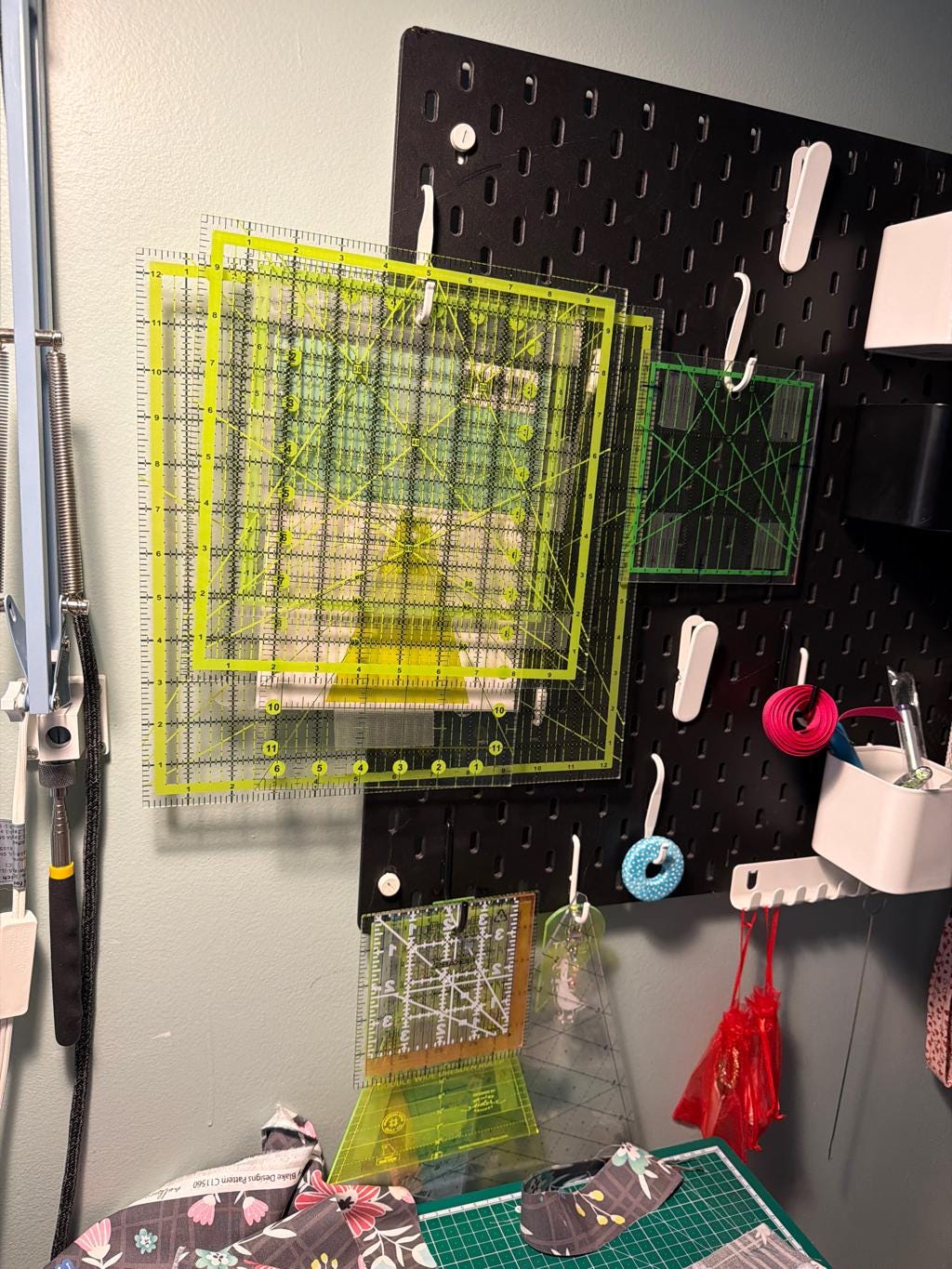
(Photo by Niemi )
Looking at what already existed
We searched for existing solutions before designing anything. MakerWorld already had publicly shared downloadable models for pegboard ruler storage, and those models helped confirm that other people were trying to solve the same problem.
But the designs we tested were optimized around different priorities from ours.
From an FDM-printing perspective, parts of the load path depended heavily on strength across the Z-axis—the direction between printed layers. That can become a weak point when a tall, heavy ruler pulls forward on the holder. The geometry also required a significant amount of support material, which increased filament use and print time.
That does not make the original model a bad design. It simply meant it was not the product we needed if we wanted to manufacture it repeatedly and send it affordably to sewing enthusiasts around the world.
Our design brief became clearer:
- Store several rulers in a small pegboard area
- Separate the rulers so they remain easy to identify and remove
- Put material where it contributes most to structural strength
- Reduce unnecessary print supports and waste
- Keep the package light enough for international shipping
- Support more than one installation position where possible
Version 1: It worked—but it was far too heavy
Our first version focused almost entirely on proving the storage idea.
It used two substantial printed sections and plenty of material around the structural areas. The result felt reassuringly solid, but it was not efficient. The complete two-part version weighed well over 400 g and, in its heavier configuration, approached 700 g.
At the time, international postage alone came close to US$15. Once we added printing time, material, packaging, and shipping, it became difficult to offer the holder at a price that made sense for customers outside our local market.
Still, we needed to know whether the storage concept itself was useful. We sent the first version to the same sewing customer whose photos had inspired the idea.
The feedback was encouraging: the holder worked. Multiple rulers could stand vertically in one compact area, and the desk was easier to use.
That was the moment the project moved from an interesting prototype to something worth refining.
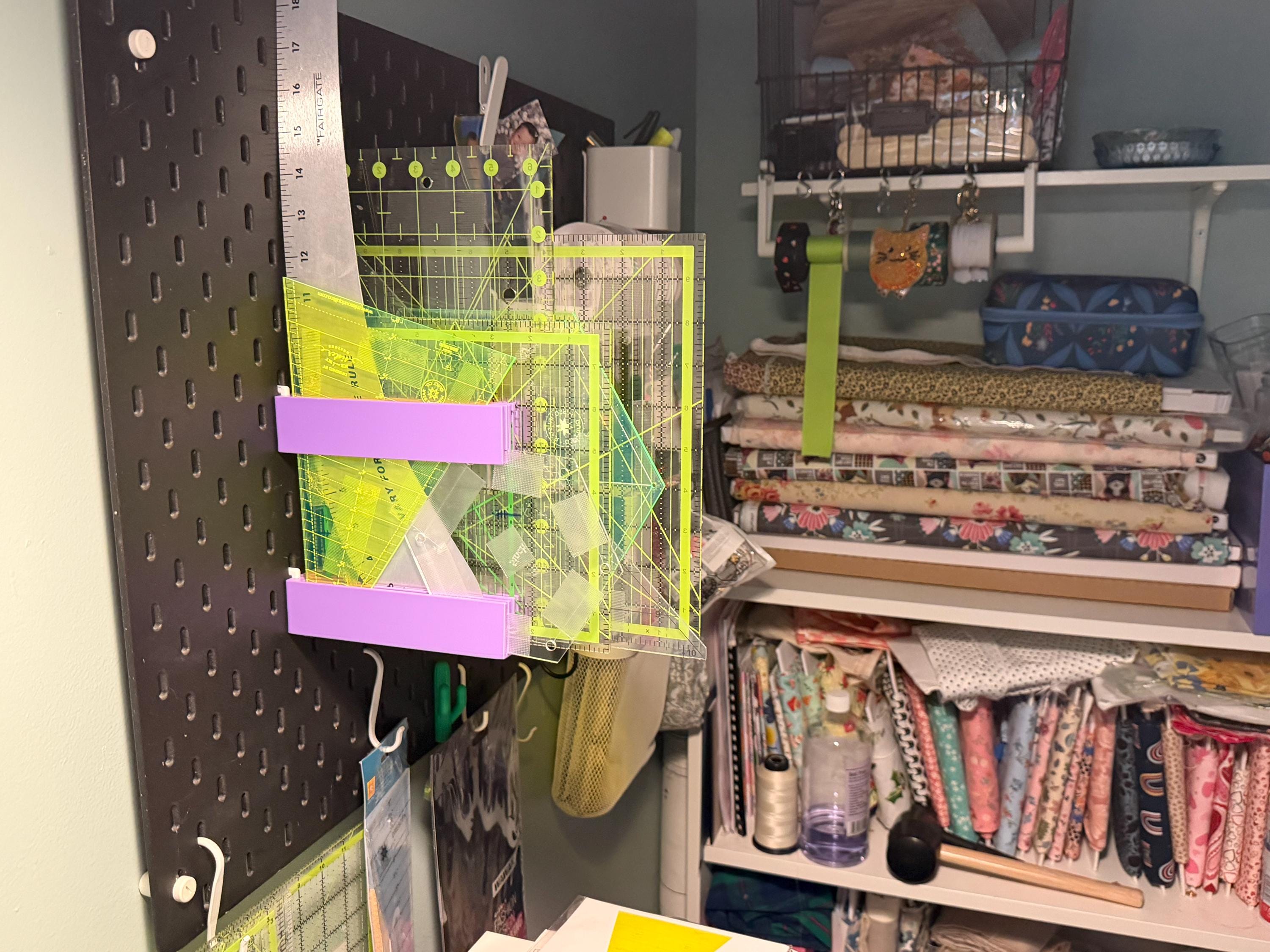
(Photo by Niemi sent back to us)
Version 2: Using material where it mattered
For the second version, we stopped treating every wall and divider as if it needed the same amount of material.
We reinforced the areas carrying the load, removed mass from areas that were doing less structural work, and reduced the height of the dividers where a taller wall did not improve the way the rulers were stored.
The holder became lighter without losing the function the customer valued.

We also realized that front mounting was not the only useful arrangement. Pegboard space is often more valuable than the wall space immediately beside it, so we developed left-side and right-side versions. These allow the rulers to sit beside the board rather than covering more of its front surface.
That choice is especially useful for smaller SKÅDIS boards or crowded sewing stations. A customer can use the main board for scissors, thread, small tools, and bins while moving the large rulers toward an outside edge.
Version 2 is still the configuration customers choose most often today. It became the practical center of the product family: lighter, easier to ship, and available in front-, left-, and right-side mounting options.

Version 3: Solving the “nose-down” problem
Then feedback from an Amazon customer revealed a problem we had not seen clearly in the original SKÅDIS setup.
On some metal pegboards, a forward load can make the panel or the mounted connector flex slightly. When that happens, the outer edge of a ruler holder can sit lower than the edge closest to the board. We call this a “nose-down” position.
For a hook, a small angle may not matter. For a holder carrying several tall, smooth acrylic rulers, it matters a lot. Once the holder tilts forward, the rulers are more likely to slide toward the open edge.
We did not want to solve that problem by simply adding more material everywhere. Instead, we changed the resting geometry.
Version 3 adds a 4 mm upward rise to the holder base. The incline is designed to counter the downward angle that can appear when the board or connector flexes under forward load. Rather than starting perfectly level and then tipping downward, the base begins with a slight upward bias.
We now use this geometry for the MakersFind ruler-holder versions designed around 1-inch hole spacing.
This does not mean every metal pegboard will deform, or that the holder can compensate for an incorrectly installed or overloaded panel. Metal board construction, reinforcement, mounting, thickness, and load position all affect the result. The change addresses a specific pattern we observed through customer use.

Version 4: Fixing a manufacturing problem created by the last improvement
Product development has a habit of doing this: one improvement reveals the next problem.
The thicker solid transition added for Version 3 changed the way heat moved through the part during FDM printing. Large solid areas cool and shrink differently from thinner walls. On some colors and print conditions, that produced visible cooling bands, slight color differences, and shallow depressions on the outer surface.
The holder still worked, but the appearance was not as consistent as we wanted.
Version 4 is the current development version. We are redesigning the transition between the solid base and the surrounding walls, adding more deliberate angled and faceted geometry instead of allowing the section to change abruptly.
The goal is to preserve the 4 mm corrective incline while managing the transition more cleanly during printing. If the change works as intended, the part should retain the functional improvement from Version 3 with a more consistent exterior finish.
It is a small visual detail, but it matters to us. A product can solve the storage problem and still deserve another iteration.

What four versions taught us
The ruler holder did not come from a trend report or a planned product category. It came from paying attention to what a customer showed us while we were solving something else.
The first customer helped us correct a thread spool holder for Gütermann spools. The same customer’s photos revealed the ruler-storage problem. Another customer confirmed that the first ruler holder was genuinely useful. Later Amazon feedback exposed the nose-down behavior on some metal panels. Our own production runs then showed us the surface issue created by the new solid transition.
Each step came from a different kind of evidence:
- A compatibility complaint
- A photograph of a real workspace
- A prototype used by a sewing customer
- Marketplace feedback from another pegboard system
- Repeated observations during manufacturing
That process is a good reminder that customer feedback is not only a list of complaints. Sometimes the most valuable information is in the background of a photo, in the way a workspace has been arranged, or in a problem the customer has stopped noticing because they have lived with it for so long.
Where the ruler holder is today
The current MakersFind sewing ruler holder stores multiple quilting and sewing rulers vertically and is available in front-, left-side, and right-side configurations. Supported pegboard options vary by product selection, so customers should check the Compatibility section before ordering.
You can view the current 8/9-slot MakersFind sewing ruler holder and choose the mounting direction that fits your workspace.
Version 4 is still being refined. We will keep testing it, printing it in different colors, and looking closely at the transition area before deciding whether it is ready to replace the current production geometry.
We did not expect this holder to become one of the products sewing customers responded to most strongly. We are grateful that it has—and even more grateful to the customers who helped shape every version.
That is how we want MakersFind products to develop: from a real space, through real use, and one useful improvement at a time.
Brand and specification notes
Gütermann is a sewing-thread brand operated by Gütermann GmbH. MakersFind is not affiliated with or endorsed by Gütermann, IKEA, MakerWorld, or Amazon. Brand names are used only to describe the customer’s original product and the pegboard or marketplace context discussed in this story.
Weights, shipping cost, and the 4 mm geometry described above are MakersFind development observations from this product’s iteration history. Product specifications and available compatibility options should always be confirmed on the current product page before ordering.